Posted September 21, 2026

By Matt Insley
Breaking China’s Grip in Minnesota
When Paradigm’s Matt Badiali talks about critical minerals, I pay attention.
Matt is a trained geologist and former mining company CEO. He’s spent his career studying the resources that make the modern economy work — and the companies that produce them.
Today, he’s looking at one resource China has spent decades dominating.
But Matt sees a potential way around that dominance. And it doesn’t start with digging another mine.
I’ll let him explain…
Beijing’s Magnetic Leverage
The combination of scarcity plus utility creates valuable commodities. And that describes rare earth metals perfectly.
Rare earth metals are essential to many of today’s most important technologies, mainly in the form of permanent magnets.
These strong, small magnets go into everything these days: electric motors, hard disk drives, cell phones, speakers, headphones, MRI machines, precision-guided missiles, military communications and much more.
The problem with rare earth metals is that China dominates supply. It’s not that the country has all the deposits, but rather that it dominates the refining and manufacturing needed to turn those deposits into useful products.
According to the International Energy Agency (IEA), China accounts for:
- 60% of magnet rare earth mining
- More than 90% of magnet rare earth refining
- Nearly 95% of rare earth permanent magnet manufacturing
That gives China an overwhelming economic lever to put pressure on other countries.
We got an early look at that power in 2010, when shipments of rare earths from China to Japan were disrupted during a territorial dispute. Japan’s auto and electronics industries suddenly faced a serious supply threat.
More recently, China tightened its grip again.
Your Rundown for Monday, September 21, 2026...
Breaking China’s Grip in Minnesota
In late 2024, Beijing restricted exports to the U.S. of several critical minerals, including gallium, germanium and antimony. Those aren’t rare earths, but the message was the same: China was willing to use its dominance of critical-material supply chains as economic leverage.
Then, in April 2025, China imposed export controls on seven heavy rare earth elements and related magnets. Shipments fell sharply, leaving manufacturers in the U.S., Europe and elsewhere scrambling for supplies. Some automakers were even forced to cut production.
And the pressure hasn’t gone away. China has continued restricting shipments of key heavy rare earths to Japan this year amid another diplomatic dispute.
That’s the danger of allowing one country to dominate a supply chain this important.
Developing a U.S. mining, refining and magnet manufacturing chain will help. But there’s another potential solution: innovate our way around rare earths altogether.
Permanent magnets don’t have to be made from rare earths.
Several research groups are focused on alternatives. One of the most advanced is an iron-nitride permanent magnet made by Niron Magnetics. The company grew out of research led by the University of Minnesota and supported by the U.S. Department of Energy.
The co-founder of Niron, Dr. Jian-Ping Wang, is passionate about permanent magnets:
Permanent magnets are the unsung heroes of our modern society. Without them, many systems just don’t work. They convert electrical energy into mechanical motion in the most energy-efficient way. They’re in everything.
Unfortunately, Niron is private. But this is exactly the kind of company that we want to own.
Magnets, like batteries, are critical to technology. The companies that can disrupt the status quo are going to make investors rich.
And Niron has made significant progress since I first wrote about it.
In August, the company secured a $150 million loan to help build its first commercial-scale manufacturing plant in Sartell, Minnesota. Then, earlier this month, Honda announced an investment in Niron.
Construction is moving ahead, too. On Sept. 10, Niron held a steel-raising ceremony at the 287,000-square-foot Sartell plant.
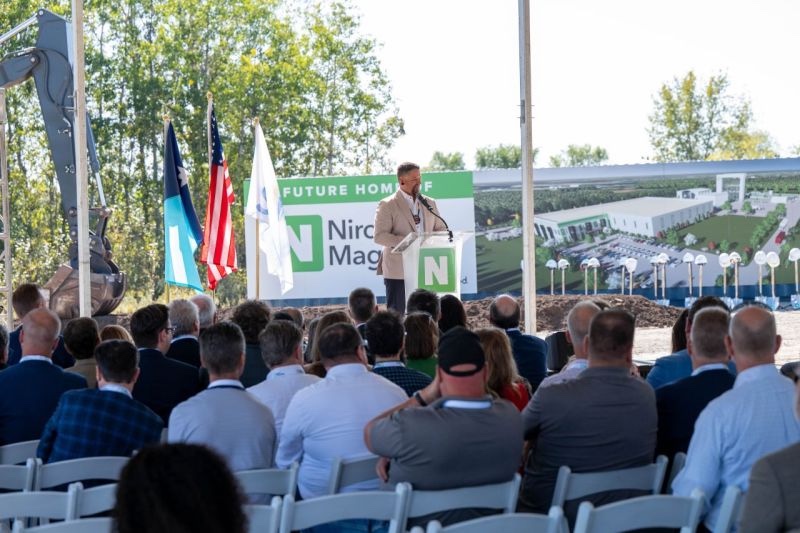
Courtesy: LinkedIn
The facility is expected to begin operating in 2027, eventually producing up to 1,500 tons of rare-earth-free magnets per year.
And that’s just the beginning.
Niron is also planning a much larger 1.6 million-square-foot manufacturing facility capable of producing 10,000 tons of magnets annually. The company estimates that could eventually represent roughly 1–2% of global permanent-magnet demand.
Don’t get me wrong. One company won’t derail the need for rare earth magnets.
But Niron points to a future where China has real competition. And more importantly, it shows that there may be another way to break China’s grip on one of the world’s most important technology supply chains.
China has shown repeatedly that it will use its near-monopoly as leverage when it suits its interests.
The best long-term answer may not be trying to beat China at its own rare earth game.
It may be making that dominance matter a whole lot less.
Market Rundown for Monday, Sept. 21, 2026
S&P 500 futures are up 0.70% to 7,765.
Oil is down 2.55% to $97.75 for a barrel of WTI.
Gold is down 0.70% to $4,394.40 per ounce.
And Bitcoin’s up almost 5% to $85,175.
Wednesday’s OTHER D.C. Vote
Posted September 18, 2026
By Matt Insley

Six Years of Inflation, Measured in Silver
Posted September 16, 2026
By Matt Insley
Qatar’s Great NatGas Reversal
Posted September 14, 2026
By Matt Insley

California’s Unions Turn on Each Other
Posted September 11, 2026
By Matt Insley

Pink Slip Pete
Posted September 09, 2026
By Emily Clancy
