Posted March 23, 2026

By Matt Insley
Gold Had One Job
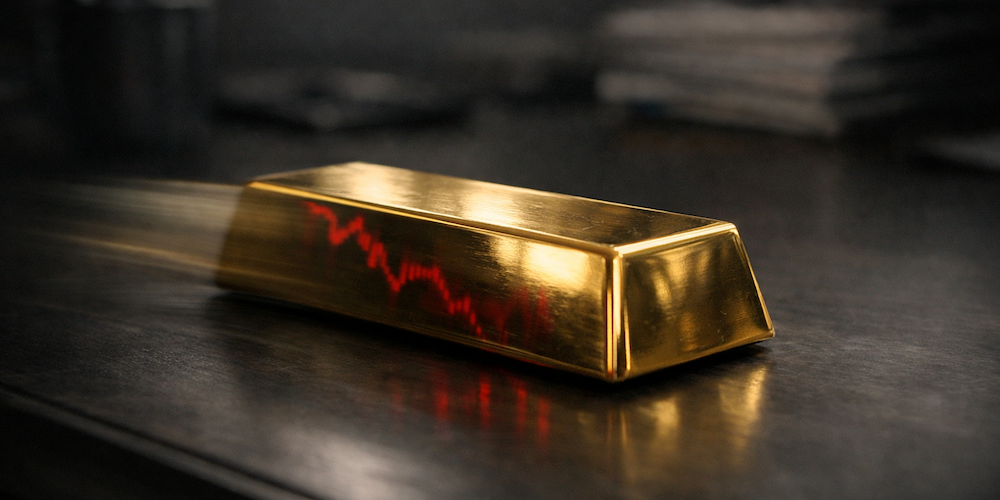
This is supposed to be gold’s moment.
War in the Middle East. Sticky inflation. Markets on edge.
If gold is ever going to behave like a true safe haven, this is when it should show up.
And yet, it hasn’t.
Gold dropped 11% last week, posting its biggest weekly loss since 1983. The yellow metal, in fact, is down more than 14% since the war began — a drop so sharp the Wall Street Journal claims investors “would have been better off in the tiniest microcap stocks than in the oldest source of safety.”
(Now let’s not get hyperbolic here, but point taken.)
And the usual explanations don’t quite hold water. Yes, the dollar has strengthened since the conflict started, which typically pressures gold.
Yes, real interest rates — particularly yields on Treasury Inflation-Protected Securities (TIPS) — have moved higher. When those yields rise, cash and bonds become more attractive, making assets like gold comparatively less appealing.
But those correlations only go so far. And on one of the most trying days of the conflict, the dollar actually weakened — while gold still suffered one of its steepest declines.
So if the macro story doesn’t satisfy, what gives?
Your Rundown for Monday, March 23, 2026...
Why Sell This Trustworthy Asset?
By the time this latest Mideast crisis hit, gold was no longer an overlooked hedge. It had become a popular trade.
Central banks have been buying aggressively, reallocating reserves away from dollars after Russia's assets were frozen in 2022.
That steady sovereign demand helped push gold prices to historic highs — the metal touched a record just below $5,600 an ounce in late January, capping a staggering 66% surge in 2025 .
Then institutional money followed. Then retail investors joined in, chasing the trend.
But when stress enters the system, popular trades tend to behave the same way — they sell. Not because they’re broken, but because they’re liquid.
Which is why some perspective from Paradigm’s macro authority Jim Rickards is so invaluable. “It's not unusual at the early stage of a crisis to see gold prices go down,” he says.
“Yes, it’s a war, but it’s also a financial and monetary meltdown… There is a private credit panic going on in the United States.”
In other words, the visible crisis — geopolitics — is only half the story. Beneath it, stress is building in private credit markets, private equity funds and other corners of finance that rely heavily on borrowed money.
Private credit refers to loans made by non-bank lenders — think asset managers like Blackstone or Blue Owl — directly to companies, rather than through public bond markets.
These funds grew enormously over the past decade. Retail investors eventually got access through semi-liquid vehicles — funds you could usually redeem quarterly, even though the underlying loans might not mature for years.
That mismatch is now the problem.
BlackRock, for instance, restricted withdrawals on its $26 billion HPS Lending Fund. And Morgan Stanley met only 45.8% of investor redemption requests in its flagship North Haven Private Income Fund in Q1 2026.
“What happens when the redemption notices start piling up? It’s a kind of run on the bank,” Jim explains. In response, these private credit and private equity funds have “put up the gates,” he says.
“So, if you're an investor, what do you do in a situation like that? One of the things you can do is sell gold… precisely because gold is relatively liquid and you can get cash.
“It's not that people don’t want gold,” he adds, “but it might be the only thing that they can sell.”
That’s the hidden logic behind gold’s strange behavior recently. It’s not abandonment — it’s triage.
True, gold isn’t “skyrocketing,” Jim notes. “[The price] could bounce around… but that's not a crash. The strong hands are going to wait to see gold trend down,” he concludes. “At some point, they’ll jump in.”
In moments like these, it’s important to remember that markets don’t always behave the way they’re supposed to. Safe havens don’t always rise on cue. The first move in a real crisis isn’t always a flight to safe havens.
It’s toward liquidity. And sometimes, the very asset investors bought for safety is the first one they sell for cash.
Market Rundown for Monday, March 23, 2026
S&P 500 futures are up 1.30% to 6,645.
Oil’s down 5.40% to $92.80 for a barrel of WTI.
Gold is down 4.85% to $4,346.20 per ounce.
Bitcoin’s up 2.65% to $70,175.

No Fertilizer, No Food, No Order
Posted March 20, 2026
By Matt Insley

A New Urban Bloc Fights “Federal Overreach”
Posted March 18, 2026
By Matt Insley

The Quiet Casualty of Mideast Conflict
Posted March 16, 2026
By Matt Insley

Your Social Security Is Being Skimmed
Posted March 13, 2026
By Matt Insley

Rickards: Mullahs and Midterms
Posted March 11, 2026
By Matt Insley