Posted July 13, 2026

By Matt Insley
Lindsey Graham’s Unusual Portfolio
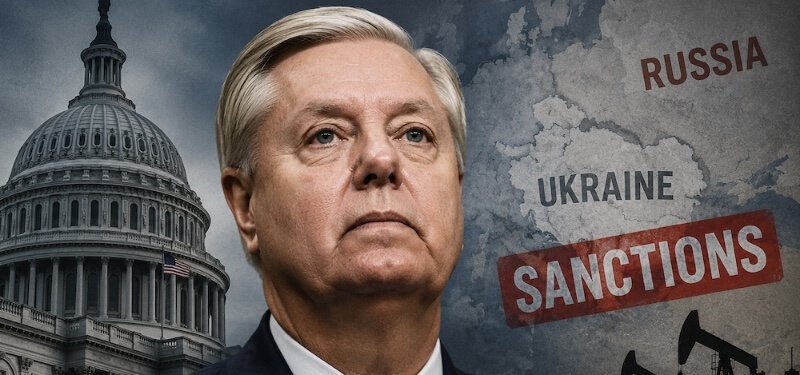
On Saturday, emergency crews were sent to Lindsey Graham’s townhouse on South Capitol Street, just a few blocks from the U.S. Capitol.
According to emergency dispatch reports, crews responded to a report of chest pains shortly before 8:30 p.m. They later performed CPR after the patient went into cardiac arrest. Graham’s office has confirmed only that the 71-year-old senator died following a “brief and sudden illness.”
The timing made his death even more jarring.
On Friday, Graham had been in Kyiv, meeting Ukrainian President Volodymyr Zelenskyy. It was Graham’s tenth visit to Ukraine since Russia’s full-scale invasion.
On Saturday evening, President Trump spoke with him by phone and recalled that Graham sounded tired but otherwise fine. Hours later, he was dead.
Most of the obituaries will focus on Graham’s long career, his transformation from Trump antagonist to Trump ally and his unwavering support for Ukraine, Israel and a muscular American foreign policy.
But his financial disclosures reveal an overlooked detail that helps explain the man better than any collection of obituaries.
Lindsey Graham spent decades in Congress without becoming a great stock picker.
That distinction is more unusual than it sounds.
Members of Congress are legally permitted to buy and sell individual company shares, even when those holdings overlap with their legislative responsibilities.
A 2025 Campaign Legal Center analysis found that 56 sitting senators owned individual stocks, while 42 owned only widely held funds such as mutual funds, ETFs and pensions.
Graham belonged to the second group.
His 2025 disclosure included the T. Rowe Price Blue Chip Growth Fund, the Vanguard U.S. Growth Fund, the Dodge & Cox Stock Fund, bond ETFs and cash.
Quiver Quantitative estimated his net worth at roughly $1.5 million, ranking him 287th in Congress, with about $414,000 in trackable publicly traded assets.
He did make transactions, but the reported trades were largely between funds: selling a dividend ETF, buying Treasury and bond funds and moving money among diversified vehicles.
But he was no Nancy Pelosi,
There was no sprawling collection of individual technology companies, no parade of options trades and no reputation for somehow discovering tomorrow’s winners before everybody else.
For a man who entered elected office in 1992 and spent more than three decades around Washington’s most valuable information, Graham’s personal portfolio was remarkably ordinary.
His path to Washington wasn’t.
Your Rundown for Monday, July 13, 2026...
A Cold War Holdover In Trump’s GOP
Graham grew up behind the restaurant and pool hall his parents operated in Central, South Carolina.
His mother died when he was in college. His father followed about 15 months later, leaving Graham to help raise his teenage sister.
He became the first member of his family to graduate from college, earned a law degree and served as an attorney in the Air Force Judge Advocate General’s Corps before entering politics.
By the end of his life, Graham was undeniably a career politician. He served in the South Carolina House, the U.S. House and then the Senate, where he became one of Washington’s most recognizable voices.
Yet he never appeared especially interested in turning that access into Wall Street success.
Instead, Graham invested his political capital in a post-Cold War vision of American power — one that held America’s strength was most valuable when deployed abroad, before danger reached home.
He believed in military alliances, overseas bases, sanctions, weapons sales and the deterrent power of an aircraft carrier appearing on the horizon.
President Trump rose by challenging some of those assumptions.
He campaigned on the idea that America's allies had received too much protection for too little in return, that wars had consumed American blood and treasure and that economic power, tariffs and secure borders mattered as much as distant military commitments.
But after savaging him during the 2016 campaign, Graham eventually became one of President Trump’s closest allies.
One day before his death, in fact, Graham announced that a bipartisan group of senators had reached an agreement with the Trump administration on a sweeping Russia sanctions bill.
The legislation would give President Trump new authority to impose steep tariffs and other economic penalties on countries that continue buying Russian oil and gas, increasing pressure on one of the Kremlin’s most important sources of revenue
Graham believed the added leverage would help bring Russia to the negotiating table.
Now, politicians on both sides of the aisle say the best way to honor Graham would be to pass this legislation.
Will Graham’s death give his sanctions bill new life?
Or did the Senate just lose the one Republican uniquely positioned to sell an old-school foreign-policy tool?
The answer may determine not only the fate of Graham’s final bill, but whether the Republican Party still has room for the kind of foreign-policy vision he spent decades defending.
Market Rundown for Monday, July 13, 2026
S&P 500 futures are down 0.35% to 7,590.
Oil is up 3.65% to $74 for a barrel of WTI.
Gold is down 1% to $4,069.20 per ounce.
And Bitcoin is down 2.50% to $62,540.

Jim Rickards: Inflation Is Misunderstood
Posted July 10, 2026
By Matt Insley

Poker > Wall Street
Posted July 08, 2026
By Matt Insley

A Butcher. A Veteran. A Steelworker.
Posted July 06, 2026
By Matt Insley

The Philadelphia Philosopher
Posted July 03, 2026
By Matt Insley
America’s 7 Superpowers
Posted July 01, 2026
By Matt Insley
