Posted October 26, 2026

By Matt Insley
Little Marco, Big Question Mark
Back in August 2025, I wrote about what I called “The Trump-RUBIO-Vance Triangle.”
Fourteen months later, Trump still hasn’t named his successor.
Last week, Vance told journalist Mark Halperin that he expects Trump’s endorsement if he runs for president. Vance also admitted that the two haven’t discussed it.
Trump has praised his vice president without committing to an endorsement. With the Nov. 3 midterms approaching, the president said it was too early to make that decision.
Vance is the sitting vice president and a close Trump ally. Rubio, however, brings nearly three decades of political experience to the conversation.
Rubio began his political career in 1998 as a city commissioner in West Miami. Two years later, he won a seat in the Florida House of Representatives, where he rose to become speaker in 2006.
In 2010, Rubio won a U.S. Senate seat in the Tea Party wave. He ran against Trump for the Republican presidential nomination in 2016, endured Trump’s “Little Marco” nickname and eventually became one of Trump’s most prominent Cabinet officials.
Today, Rubio serves as secretary of state and national security adviser, a combination of responsibilities previously held by Henry Kissinger.
Rubio has publicly said he’d support Vance if the vice president seeks the Republican nomination. Neither politician has announced a 2028 campaign.
Still, Rubio has an organization in his corner. America 2100, a conservative nonprofit founded in 2023 by political allies, reportedly holds nearly $3 million in reserve.
The Washington Post described the organization as a potential political “rainy day” fund for Rubio, should he decide to pursue the presidency in 2028.
For investors, Rubio’s voting record tells us more than speculation about the 2028 presidential race.
Your Rundown for Monday, October 26, 2026...
Rubio’s 28-Year Economic Record
Rubio arrived in Washington promising fiscal discipline, smaller government and lower taxes. But his economic record begins much earlier.
As a West Miami commissioner, Rubio voted for city budgets in 1998 and 1999 that increased property tax revenue by 1.4% and 5.5%, respectively. The city kept its tax rates unchanged but collected more money as property values rose.
As Florida House speaker in 2007, Rubio proposed eliminating property taxes on primary residences and replacing the lost revenue with a higher state sales tax.
The proposal never became law. But Rubio helped negotiate a different reform package that reduced certain local property tax rates and restricted future increases.
The episode offers an early glimpse of Rubio’s willingness to consider a fundamental restructuring of the tax system, even when the changes would affect homeowners and consumers differently.
His Senate record provides a clearer picture of his positions on major federal economic legislation.
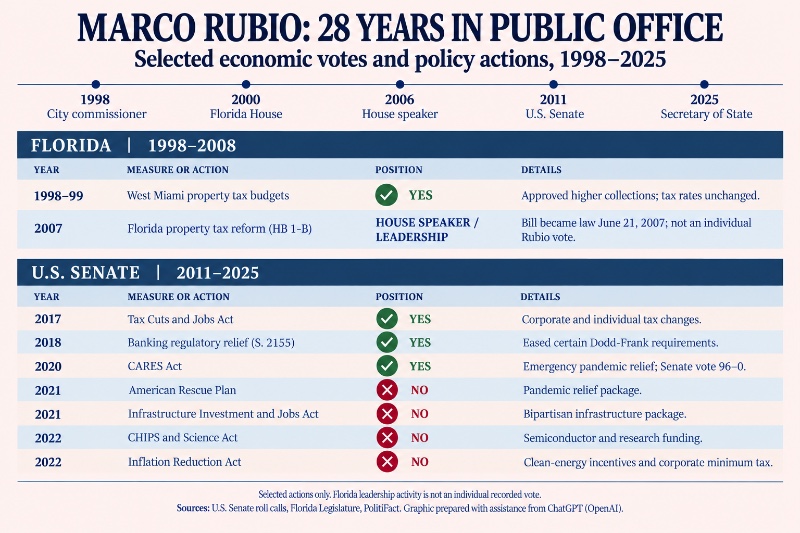
In 2017, Rubio voted for Trump’s Tax Cuts and Jobs Act, which lowered the federal corporate income tax rate from 35% to 21%. He also pressed for a larger child tax credit.
In 2018, he supported legislation easing certain banking regulations imposed after the 2008 financial crisis.
Rubio also supported the $2.2 trillion CARES Act in March 2020, when Congress responded to the economic emergency created by COVID-19.
He later opposed President Biden’s $1.9 trillion American Rescue Plan in 2021 — the bipartisan infrastructure legislation that year — and the Inflation Reduction Act in 2022.
His opposition to the CHIPS Act is especially revealing.
In February 2019, as chairman of the Senate Small Business Committee, Rubio released a report titled Made in China 2025 and the Future of American Industry.
He argued that China was using industrial policy to build dominance in strategically important technologies, threatening American manufacturing, innovation and national security.
Rubio called for an American response that went beyond conventional tax cuts and deregulation.
Yet three years later, he voted against the CHIPS Act, despite its billions in federal support for American semiconductor manufacturing. Rubio supported the broader objective while rejecting the legislation Congress produced.
His overall voting record combines support for tax reductions and banking deregulation with an interest in federal policies designed to strengthen strategic American industries.
For investors, Rubio’s economic philosophy puts semiconductors, defense manufacturing, critical minerals and domestic supply chains in the spotlight. His emphasis on national security and American industrial independence suggests those industries would remain important priorities.
But rebuilding America’s industrial base comes at a price.
Federal subsidies and military spending require funding, while tariffs can increase costs for American businesses and consumers. Combine those policies with tax cuts, and the consequences could extend well beyond individual industries to federal deficits, Treasury yields and corporate profits.
Rubio’s Senate votes don’t provide a complete answer to how he’d manage the national debt or approach Federal Reserve policy. Nor do they amount to a presidential economic platform.
But they establish a record against which future promises could be measured.
Eight days before the midterms, Trump has yet to settle the question of who should carry his political movement into 2028.
Rubio’s nearly three decades in public office tell us more about his economic priorities than mere speculation about his next job title.
Market Rundown for Monday, Oct. 26, 2026
S&P 500 futures are up 0.40% to 7,690.
Oil is down 2% to $101.20 for a barrel of WTI.
Gold’s up 0.70% to $4,036.20 per ounce.
And Bitcoin’s down 0.35% to $80,195.
Soros and Scott: The Sequel
Posted October 23, 2026
By Matt Insley

Trump Channels Graham Platner
Posted October 21, 2026
By Matt Insley

Motion Lotion
Posted October 19, 2026
By Matt Insley

Bethlehem Steel’s Birthright
Posted October 16, 2026
By Emily Clancy
Ilhan Omar’s October Surprise
Posted October 14, 2026
By Matt Insley