Posted July 20, 2026

By Matt Insley
Newsom's Plan B for Billionaires
California has never been shy about trying new things.
It gave us Silicon Valley, the drive-thru and avocado toast. It also gave us some of the country’s highest taxes, most expensive housing and, increasingly, some of its most consequential political experiments.
This November, Californians may vote on another first.
A ballot initiative would impose a one-time 5% tax on the “paper wealth” of every billionaire who was a California resident as of Jan. 1, 2026. Supporters say the revenue — an estimated $100 billion — would help replace healthcare funding reduced under President Trump’s One Big Beautiful Bill.
Unlike an income tax or capital gains tax, this proposal targets accumulated wealth itself: privately held businesses, stocks, bonds, venture capital stakes and other financial assets whose value exists largely on paper.
Certain real estate holdings and some pension assets are generally carved out, but the proposal would still represent the first statewide tax in America aimed directly at wealth rather than income.
Not surprisingly, some of California’s wealthiest residents are fighting back.
Google co-founder Sergey Brin has reportedly committed tens of millions of dollars to defeat the measure. Several other prominent technology investors have joined the effort, arguing the proposal would punish investment and encourage entrepreneurs to build their companies outside California.
But perhaps the most fascinating reaction has come from California Gov. Gavin Newsom.
Your Rundown for Monday, July 20, 2026...
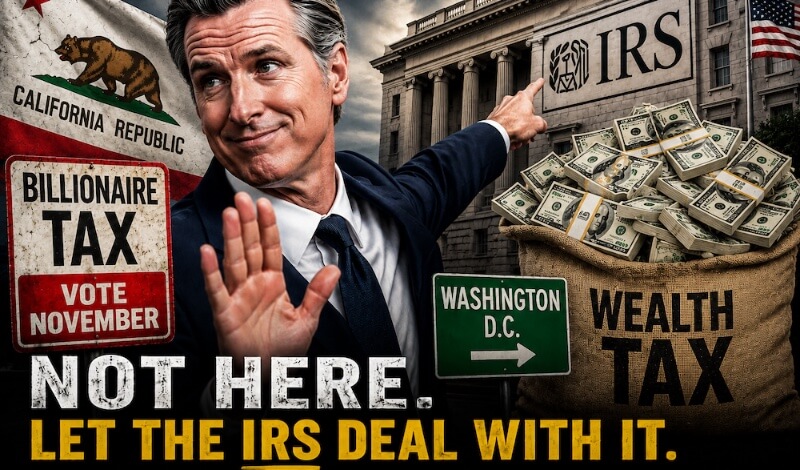
Newsom’s Wealth Tax Escape Hatch
Newsom isn’t embracing California’s billionaire tax.
He’s trying to export it.
In a recent Substack essay, Newsom argued that taxing billionaires at the state level risks driving them across state lines. Instead, he called for a national billionaire tax.
In other words, the governor isn’t saying the idea is flawed. He’s saying Sacramento shouldn’t be the one picking up the tab.
Newsom would rather let the IRS deal with billionaires.
It’s a remarkable political maneuver.
Support the policy.
Oppose the implementation.
Forward the paperwork to Washington.
The stakes — of course! — extend far beyond California.
Jim Rickards has warned that proposals like this aren’t appearing in isolation. They’re part of a broader political movement led by the Democratic Socialists of America (DSA), a group gaining influence inside the Democratic Party.
“They favor wealth taxes,” Jim says. “That means after you pay income tax and invest the remainder, they want to tax the assets themselves, not just the income.”
That’s an important distinction.
Supporters argue, however, that billionaires have accumulated extraordinary fortunes while paying relatively little tax on unrealized gains.
Opponents counter that taxing paper wealth would discourage investment and create incentives for wealthy residents to relocate.
Opponents also aren’t convinced the debate ends with billionaires.
History suggests tax thresholds have a way of changing.
When the federal income tax was introduced in 1913, for instance, relatively few Americans paid it. Over time, Congress repeatedly expanded its reach.
That’s one reason investors should pay close attention to California’s vote.
Ballot measures frequently reveal where policymakers want to go — long before they show where they’ll stop.
Today’s debate centers on fortunes measured in billions. Tomorrow’s debate may not.
As Jim cautions: “Investors need to know what’s coming before the DSA knocks on your door.”
That may sound dramatic.
But California’s ballot isn’t just another state tax proposal. It’s a referendum on a much bigger idea: Should government tax wealth itself rather than the income it produces?
California voters will answer that question first.
If they approve the measure, don’t expect the debate to stay within California’s borders for long.
And if Governor Newsom has his way, it won’t stay in Sacramento at all.
He’d rather Washington collect the bill.
Market Rundown for Monday, July 20, 2026
S&P 500 futures are up 0.35% to 7,525.
Oil’s slightly down to $82.45 for a barrel of WTI.
Gold’s down 0.10% to $4,015.60 per ounce.
And Bitcoin is up 0.45% to $64,655.

Jim Rickards: Slower Inflation Isn’t Lower Inflation
Posted July 17, 2026
By Matt Insley

Corning’s Second Act
Posted July 14, 2026
By Matt Insley
Lindsey Graham’s Unusual Portfolio
Posted July 13, 2026
By Matt Insley
Jim Rickards: Inflation Is Misunderstood
Posted July 10, 2026
By Matt Insley
Poker > Wall Street
Posted July 08, 2026
By Matt Insley