Posted September 14, 2026

By Matt Insley
Qatar’s Great NatGas Reversal
America’s enormous natural-gas supply suddenly has another potential buyer.
The tiny Persian Gulf nation of Qatar sits atop the North Field, part of the largest natural-gas reservoir on Earth. For decades, Qatar has built its fortunes shipping liquefied natural gas around the world.
Now it needs ours.
Iranian attacks in March damaged Qatar’s Ras Laffan complex, sidelining about 12.8 million metric tons of annual LNG capacity. Repairs could take up to five years. Meanwhile, shipping through the Strait of Hormuz remains severely disrupted.
QatarEnergy is now seeking about 2–3 million metric tons of U.S. LNG annually to help meet existing commitments, particularly to Asian customers, including Japan, South Korea and India.
And Qatar is joining an increasingly long line for American gas.
In June alone, the U.S. exported 17.37 billion cubic feet per day of LNG to 37 countries.
Total U.S. natural-gas exports that month were the highest for any June since federal records began in 1973.
The Energy Information Administration expects growing LNG exports and domestic power demand to put upward pressure on U.S. natural-gas prices.
The Permian Basin is getting ready.
Send your opinions to, feedback@newsyoucanacton.com
Your Rundown for Monday, September 14, 2026...
From Gas Glut to Gas Grab
For years, West Texas had the opposite problem.
The Permian produced so much natural gas alongside crude oil that producers sometimes struggled to give the stuff away.
At the Waha trading hub, prices have repeatedly fallen below zero when Permian production overwhelmed the region’s ability to move gas to other markets.
Pipeline companies responded with a massive expansion of takeaway capacity.
The latest project is enormous.
The Solitude Pipeline System will consist of two 48-inch pipelines running from the Permian to Katy, Texas.
The first phase is designed to move about 2.25 billion cubic feet per day (Bcf/d) starting in the second half of 2029. A second phase in 2030 would double that to roughly 4.5 Bcf/d.
WhiteWater owns 50%. Devon Energy owns 25%. MPLX, Diamondback Energy and Western Midstream own the rest.
And Solitude is not alone.
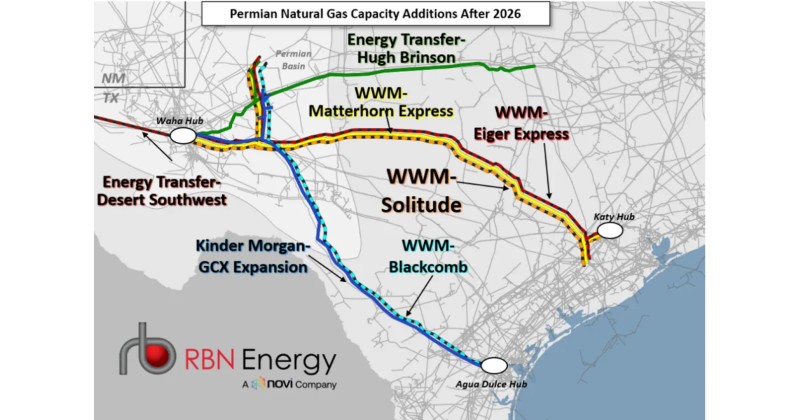
From Katy, Kinder Morgan is building its $1.8 billion Trident pipeline to move up to 2 billion cubic feet per day toward the industrial corridor near Port Arthur.
And more capacity is coming from Blackcomb in late 2026 and from an expansion of Hugh Brinson and Eiger Express in 2028.
East Daley Analytics now says the Permian could be approaching an era when gas-pipeline capacity is no longer the constraint.
The industry spent years trying to rescue stranded Permian gas. Soon, the bottleneck could move elsewhere.
Possibly to oil.
Much of the Permian’s natural gas is “associated gas,” produced alongside crude oil from wells drilled primarily for oil. East Daley estimates Permian residue-gas production could grow roughly 3 billion cubic feet per day between December 2026 and December 2028 in its base case.
But that growth depends partly on continued oil production. If crude pipelines run out of room first, producers could have less incentive to drill — limiting the additional natural gas that comes with it.
For now, companies are positioning themselves to make money moving gas from where it’s nearly worthless to where the world needs it most.
Devon Energy, one of the Permian’s major oil and natural-gas producers, is a good example.
It owns 25% of the Solitude Pipeline System, has reserved transportation capacity and has already begun securing international LNG-linked pricing for some of its Delaware Basin gas.
Devon now has a stake in the gas and the infrastructure that moves it to market.
Qatar’s problems are thousands of miles away.
But American producers are already building the infrastructure for a world that’s coming to us for natural gas.
And the most valuable part of the gas boom may not be the molecule itself. It may be the toll road underneath it.
Market Rundown for Monday, September 14, 2026
S&P 500 futures are down 0.60% to 7,680.
Oil’s up 2.80% to $102.85 for a barrel of WTI.
Gold is down 1.65% to $4,335.50 per ounce.
And Bitcoin’s up 0.90%, just under $78K.

California’s Unions Turn on Each Other
Posted September 11, 2026
By Matt Insley

Pink Slip Pete
Posted September 09, 2026
By Emily Clancy

162,000 Jobs, Give or Take
Posted September 07, 2026
By Matt Insley
Buck Sexton: The DSA Has a Pentagon Problem
Posted September 04, 2026
By Matt Insley

When Jim Rickards Spotted a Whale
Posted September 02, 2026
By Matt Insley