
Posted August 07, 2026

By Matt Insley
The Copper Bull Outlives AI
You might remember Graham Platner from our coverage this spring.
The little-known Democrat from Sullivan, Maine, surged past Gov. Janet Mills in fundraising and polling, eventually helping force the two-term governor out of the Senate race.
Then everything unraveled.
In July, a woman Platner previously dated accused him of sexual assault. Platner denied the allegation, calling the accusations against him false, but suspended his campaign shortly afterward.
“We believe for the movement to continue, it can’t be me,” he said while announcing his withdrawal.
[Now Republicans are dealing with their own candidate problem.
Ohio Rep. Max Miller is resisting pressure to abandon his reelection campaign amid allegations of domestic abuse from his ex-wife and former girlfriend.
Miller denies the allegations and has requested a House Ethics Committee investigation. The committee has obliged.]
But there’s another part of the Platner story worth mentioning.
Platner was an outspoken opponent of Maine’s rush toward massive data centers.
He backed efforts to halt new construction after communities including Sanford, Lewiston and Wiscasset pushed back against proposed projects.
Platner recognized something politicians across the country are now discovering…
Your Rundown for Friday, August 7, 2026...
The Copper Bull Outlives AI
People really don’t like data centers.
A March Gallup poll found 71% of Americans oppose building AI data centers in their communities. Nearly half strongly oppose them, period.
That brings us to Paradigm’s natural resource expert Matt Badiali.
“I think the data center buildout will fall far short of expectations,” he says.
Goldman Sachs analysts agree; they estimate only about 50–60% of U.S. data center capacity scheduled over the next two years will actually come online on time.
There are permitting problems, equipment shortages and increasingly hostile communities.
But the biggest obstacle may be electricity.
Projects can wait years just to connect to the grid. Meanwhile, the existing U.S. electrical system requires enormous investment of its own.
Which raises an important question for investors. If fewer data centers get built, what happens to the metals boom supposedly riding on their construction?
Matt recently asked exactly that question about copper. “Here’s the thing,” he says, “it’s still great.”
Data centers have become such a dominant investment narrative that it’s easy to mistake them for the entire copper story.
“You know I’m a copper bull,” Matt says. “It’s my favorite metal. It’s the key that unlocks the electricity we need for the future.
“EVs, renewable power, batteries, etc. are all incredibly copper intensive.
“Updating and expanding power grids all over the world, not just here in the U.S., requires billions of pounds of copper.”
That last point is especially important.
Even if America builds fewer data centers because the electrical grid can’t handle them, the grid itself still needs to be upgraded.
In other words, one of the biggest obstacles to the data center boom is itself a source of future copper demand.
Then there’s the other side of the equation: supply.
“We’re dealing with an aging fleet of mines that require more ore moved to produce the same amount of copper,” Matt says. “And there is currently a lack of new copper mines coming online.”
You can’t solve that problem overnight.
Finding a major copper deposit is only the first step. Developing it into a producing mine can take years of permitting, financing and construction.
Meanwhile, S&P Global estimates copper demand will climb roughly 50%, from about 28 million metric tons today to 42 million by 2040.
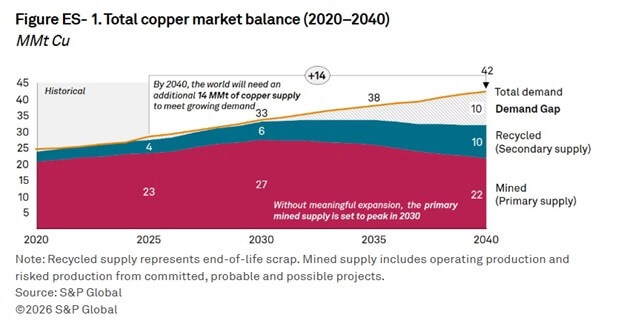
“We have not yet discovered enough mines to meet that demand,” says Matt, “let alone have them in the queue to build.”
Copper mining, in fact, is expected to peak at roughly 27 million metric tons in 2030.
That’s why he believes investors shouldn’t confuse a slowdown in data center construction with the end of the metals bull market.
“Make no mistake, data centers are not the only reason metal prices have soared,” Matt emphasizes.
Even without all that projected data-center demand, Matt expects a “structural deficit” in copper by the end of this decade.
That’s the investment story.
AI may be consuming the headlines — even the political ones — but copper demand runs much deeper than AI.
And while data center projects can be canceled, delayed or downsized, you can’t conjure a new copper mine into existence.
As Matt puts it: “Short of another massive global recession, sustained higher copper prices are inevitable.”
The data center boom could disappoint spectacularly. Copper doesn’t need it.
Market Rundown for Friday, August 7, 2026
S&P 500 futures are up 0.25% to 7,755.
Oil is down 0.85% to $76.60 for a barrel of WTI.
Gold is up almost 2% to $4,383.30 per ounce.
And Bitcoin’s up almost 1%, just under $65K.

Missiles & Misery
Posted August 05, 2026
By Matt Insley

Musk’s Mission: November
Posted August 03, 2026
By Matt Insley
Venezuela’s Rust Belt
Posted July 30, 2026
By Matt Insley

Jim Rickards: Anthony Fauci Testifies Today – Under Oath
Posted July 29, 2026
By Emily Clancy

Proxy Wars Break Cover
Posted July 27, 2026
By Matt Insley