Posted April 17, 2026

By Matt Insley
Xi’s Zugzwang
Iran thought it was playing chess. It may have just walked into a trap.
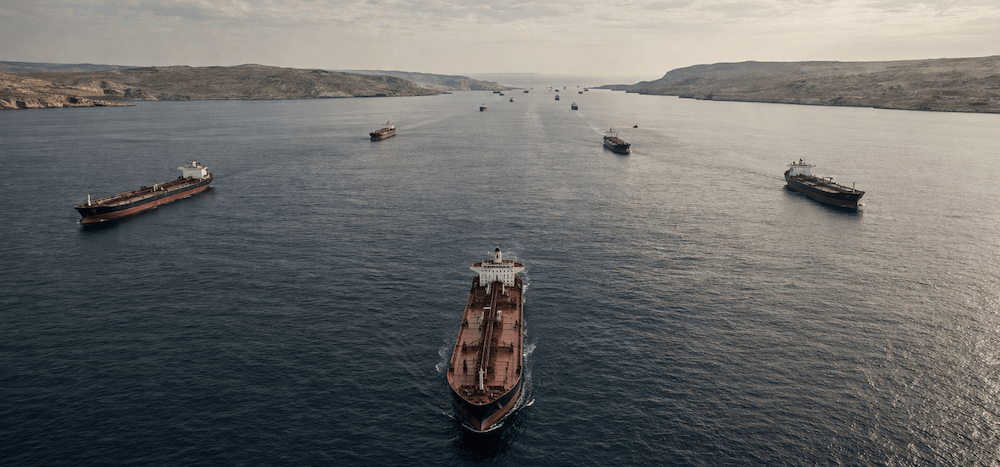
Tehran has been turning the Strait of Hormuz into a pay-to-play tollbooth. The Islamic Revolutionary Guard Corps (IRGC) started charging ships up to $2 million per vessel for transit rights beginning in mid-March — demanding payment in Chinese yuan or cryptocurrency to sidestep U.S. sanctions.
The idea: Tax the world’s most critical oil chokepoint — which carries roughly 25% of global seaborne oil trade — to squeeze Washington and pull Beijing closer.
But from the start, the strategy showed cracks.
Paradigm’s macro expert Jim Rickards — one of the original architects of the petrodollar system — has been skeptical about the yuan angle from day one.
“Originally, Iran said it would take payment in Chinese yuan, which led to speculation about the ‘petroyuan’ and a new yuan reserve currency role,” says Jim.
“That speculation is nonsense — because China has no liquid bond market in which to invest the yuan — but it still made headlines.”
The mechanics of the toll itself are murky.
“The amount of the toll has also taken several forms,” Jim continues. “One version said $2 million per vessel. Another version said $1.00 per barrel of oil onboard. Both could be true depending on the vessel and its cargo... The whole idea seems a bit ad hoc at the moment.”
He’s not wrong. The system is opaque, the intermediary collecting payments remains anonymous and ship operators have little clarity on what happens if they get it wrong.
“Ship owners could not be blamed for not trying the new system,” Jim says, “both because it’s unclear how it works and there could be severe consequences — like being sunk — if you get it wrong.”
And then came the reversal.
On April 12, following the collapse of ceasefire talks in Pakistan, Trump announced a full U.S. naval blockade of the Strait of Hormuz.
And the fallout is now landing squarely on China.
Your Rundown for Friday, April 19, 2026...
Malacca: China’s Next Chokepoint
Geopolitical analyst Andrew Korybko writes this week that Iran’s tollbooth scheme “inadvertently put China in a zugzwang” — a chess term for when every move available makes your position worse.
And the numbers are brutal.
Before the Hormuz blockade, about 13% of China’s seaborne oil imports came from Iran. Venezuela — now effectively under U.S. control — accounted for another 4%.
Add in Gulf kingdoms — Saudi Arabia, Kuwait and the UAE — and you’re looking at 35% more of China’s oil imports flowing through U.S.-influenced waters.
At this point, over half of China’s oil imports by sea are now under some degree of American control.
And it may not stop there.
The U.S. recently announced a “Major Defense Cooperation Partnership” with Indonesia — which Korybko says is setting the stage for a potential blockade of the Strait of Malacca.
To put that in perspective, two-thirds of China’s total foreign trade and more than 80% of its oil imports pass through Malacca.
If Indonesia, Malaysia and Singapore follow Iran’s lead — implementing their own toll systems — Beijing could soon find itself writing checks at every major chokepoint on the map.
So what are President Xi’s options?
Not good ones.
China — which holds the world’s largest strategic oil reserves — is unlikely to risk a direct military confrontation over Iran (when it won’t even do so over Taiwan). Breaking the blockade is off the table.
Doing nothing risks Iran’s economic collapse.
Pushing Tehran toward a deal with Washington could stabilize the situation — but may permanently cut off China’s access to Iranian oil.
China’s every move — forgive me — takes a toll.
“For now,” Jim concludes, “this toll booth idea is not producing results.”
Not the kind Iran was counting on.
And China is the one now in check. With no good moves left.
Market Rundown for Friday, April 19, 2026
S&P 500 futures are up 0.40% to 7,100.
Oil’s down 4.20% to $90.70 for a barrel of WTI.
Gold is up 0.35% to $4,825.40 per ounce.
And Bitcoin’s up 0.70% to $75,720.

Orange Swan: Chaos Without Camo
Posted April 15, 2026
By Matt Insley
Boom for Whom?
Posted April 13, 2026
By Matt Insley
Delta: We Bought a Refinery
Posted April 10, 2026
By Matt Insley
1-800-CAL-MOVE
Posted April 08, 2026
By Matt Insley

The Green New Scam Exposed
Posted April 03, 2026
By Matt Insley